Top menu bar
5 minute read
The top menu bar holds everything that moves the EtherCAT configuration in or out of the tool: the connection to the controller, Fetch and Deploy, and loading or downloading the configuration as a file. Most actions are in the main menu behind the
button at the top left. Click a button in the diagram to jump to its section.
The main menu
Press
at the top left to open the main menu. Next to the button is the name of your motorcortex.io account, or Not logged into portal. The last line of the menu shows the Version of the ECAT tool.
Connect to the controller
The tool reads the parameter tree from the controller, so you can link device data to parameters. Fetch, Deploy and Scan Bus also go to the host you enter here.
-
Open the main menu and choose
Connection, or click the connection indicator at the top right.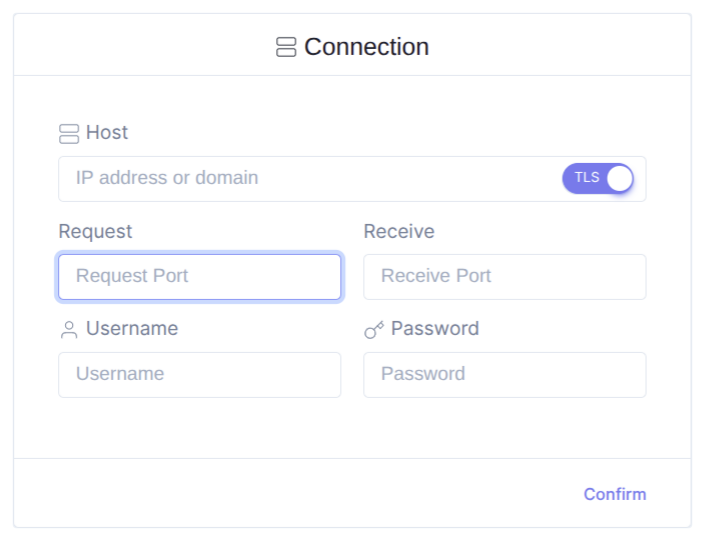
-
Fill in the fields and press
Confirm.
| Field | What it does | Default |
|---|---|---|
Host |
The address of the controller, for example controller_ip_addressThe IP address of your controller. In most cases 192.168.2.100.. You can also enter host:request/receive to set both ports at once. |
empty (required) |
TLS |
Connect over a secure connection. A Host entered as an https address switches it on. |
on |
Request |
The request port of the Motorcortex server. | 5568 with TLS, 5558 without |
Receive |
The receive port of the Motorcortex server. | 5567 with TLS, 5557 without |
Username |
Your log-in on the controller, if it asks for one. | empty |
Password |
The password for that log-in. | empty |
The connection indicator shows how the connection is doing:
- a green dot: connected,
- a red dot: not connected; the tool tries again every few seconds,
- a spinner: connecting.
Next to the dot, a closed lock means TLS is on, an open lock that it is off.
Fetch and deploy
Fetch and Deploy, at the top right, move the whole configuration between the tool and the controller.
Fetchreads the EtherCAT configuration the controller has now and shows it in the tool. If the tool already holds devices, it first asks you to confirm, because the fetched configuration replaces them.Deploysends the configuration in the tool to the controller and asks it to restart the application with it. If the configuration is empty, the tool asks you to confirm first.
While a button works it shows Fetching or Deploying, then Completed or Failed.
Warning
Deploy restarts the application on the controller with the new EtherCAT configuration. Anything the application is driving stops. Make sure the machine is in a safe state first. To send a configuration without a restart, use Preview & Deploy.
Preview before you deploy
Preview & Deploy in the main menu opens the Preview Configuration window. It shows the XML the tool will send, so you can check it first.
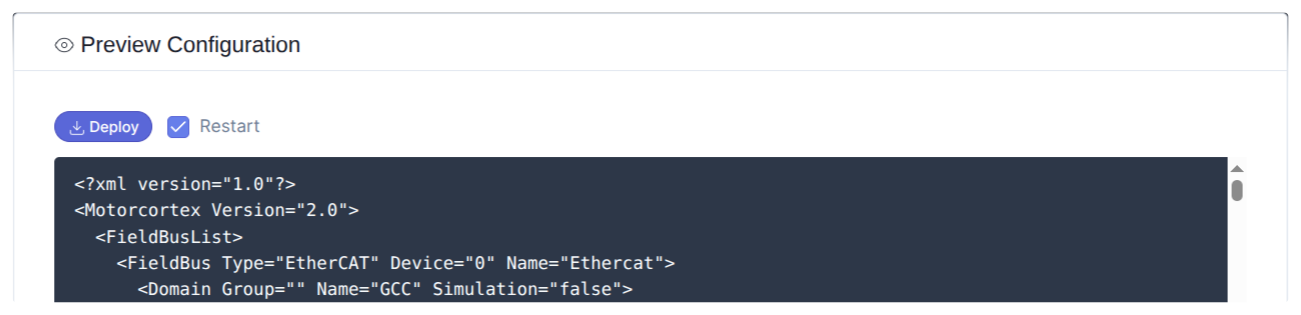
Press Deploy in the window to send it. With Restart ticked, which is the default, the controller restarts the application, as with Deploy in the top menu bar. Untick Restart to send the configuration without asking for a restart.
Start, load or download a configuration
These three work in your browser only. Nothing goes to the controller until you deploy.
-
New Configurationclears the tool and starts again with one empty domain calledDefault. If the tool holds devices, it asks you to confirm first.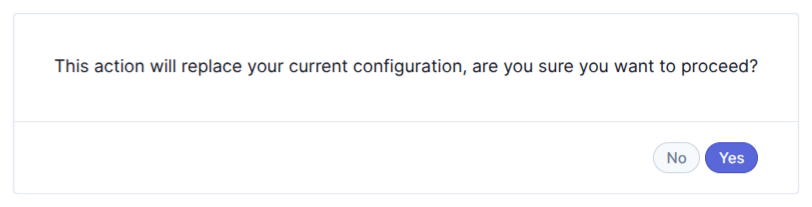
-
Load Configurationopens a configuration file from your PC, for example theio/master.xmlof a config package. It replaces what the tool holds, after the same confirmation. -
Download Configurationsaves the configuration in the tool asmaster.xmlin your browser’s download folder. It is not available while there are no domains.
Add devices
Add Devices opens the window in which you add devices from a bus scan, a configuration, device description files or by hand. The devices go to the first domain. To add them to another domain, use the
next to Devices in that domain instead. See Domains configuration panel.
EtherCAT service settings
Settings sets how the tool reaches the EtherCAT service on the controller, which does the scan, the fetch and the deploy. You only change these if your controller runs the service somewhere else. Reset restores the defaults.
| Field | What it does | Default |
|---|---|---|
Port |
The port of the EtherCAT service on the host from Connection. The service is reached over HTTPS. |
443 |
Timeout |
How long the tool waits for an answer, in milliseconds. | 7000 |
scan bus |
The endpoint that scans the bus. | /services/ethercat/scan-bus |
deploy bus |
The endpoint that receives a deployed configuration. | /services/ethercat/set-config |
get config |
The endpoint that returns the current configuration. | /services/ethercat/get-config |
get esi list |
The endpoint for the list of ESI files. | /services/esi/get_config_list |
get version |
The endpoint that reports the service’s version and features. | /services/ethercat/api/version |
Dark mode and version
The switch with the moon (
) in the main menu turns dark mode on and off. Below it, Version shows which build of the ECAT tool you are running.
Motorcortex AI
The Motorcortex AI badge appears in the top menu bar only while an AI assistant is connected to the tool through the Motorcortex EtherCAT MCP server. When the assistant works in another browser tab, the badge is dimmed; click it to move the assistant to this tab.