user/parameters.json
5 minute read
user/parameters.json adds your own parameters to the parameter tree, under root/UserParameters/. Use them for what the application does not have yet: an I/O channel of your own, a value a dashboard needs, or data another program writes in, such as coordinates from a vision system.
The application reads the file named in config.json:
"Path": {
  "UserParameters": "user/parameters.json"
}
All options at a glance
An entry with Children is a branch, a folder in the tree. An entry with a Type is a parameter.
The Type string
Type says what the parameter holds and how it behaves, in one string:
Some examples:
Type |
Creates | Typical use |
|---|---|---|
bool,input |
One true/false value that a link or a program writes | A button on an I/O module |
bool |
One true/false value you can switch; parameter_volatile by default |
A lamp you turn on from Desk |
double[6],input |
Six decimal numbers | A pose sent by a vision system |
int32[3],parameter |
Three whole numbers, kept when you save from Desk | Settings you tune once |
uint8,parameter_persistent |
One whole number from 0 to 255, kept automatically | A selected mode that must survive a restart |
char[20],parameter_volatile |
Text of up to 20 characters | A product name shown on a dashboard |
Details
Parameter types
The parameter type decides how the parameter can be linked, and whether its value is kept.
| Type | In a link | Kept after a restart | Use it for |
|---|---|---|---|
input |
destination only | no | Values coming in: an I/O input, data from another program |
output |
source only | no | Values the application produces for others to read |
parameter |
source and destination | yes, when you save from Desk (in control.xml) |
Settings you tune and keep |
parameter_volatile |
source and destination | no | Settings and outputs you switch while running. The default. |
parameter_persistent |
source and destination | yes, automatically (in the persistence file) | Values that must survive a restart without saving, such as a counter |
A link runs from a source to a destination, so an I/O input channel needs an input parameter, and an output channel is fed from a parameter you can write, such as parameter_volatile.
Start values
Warning
A Value is written at every start, after the values saved from Desk are loaded, so it replaces a saved value. Leave Value out for a parameter whose saved value you want to keep.
- Without a
Valuea number starts at0. - Arrays take a list:
"Value": [1.34, 2.23, 3.57]. A shorter list fills the array from the first element; a longer one is cut off. - Text (
charorstring) takes a string, and the length is its number of characters:"Type": "char[11]"with"Value": "Hello world". Force:truelocks the start value, so nothing can change it while the application runs.Enable:falseleaves the parameter out of the tree altogether.
A complete file
{
  "Version": "1.0",
  "Children": [
    {
      "Name": "IO",
      "Children": [
        { "Name": "Gripper1", "Type": "int32[1],parameter_volatile", "Value": 0 },
        { "Name": "Gripper2", "Type": "int32[1],parameter_volatile", "Value": 1 }
      ]
    },
    {
      "Name": "Branch2",
      "Children": [
        { "Name": "branch2Param1", "Type": "int32[3],input", "Value": [2, 3, 4] },
        { "Name": "branch2Param2", "Type": "int32[3],input" },
        {
          "Name": "subbranch1",
          "Children": [
            { "Name": "branch2subbranch1Param1", "Type": "char[11],parameter_volatile", "Value": "Hello world" },
            { "Name": "branch2subbranch1Param2", "Type": "int,parameter_volatile", "Value": 123 }
          ]
        }
      ]
    },
    { "Name": "moduleParam1", "Type": "double[6],input", "Value": [1.34, 2.23, 3.5675, 4.0034, 5.5677, 6.2345] },
    { "Name": "moduleParam2", "Type": "bool,input" }
  ]
}
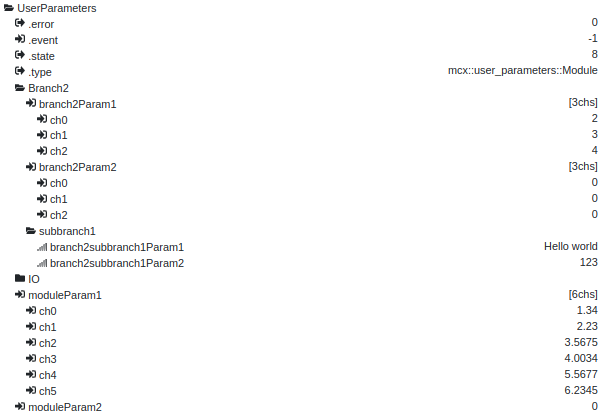
In Desk this file gives the tree below. branch2Param2 has no Value, so its three elements start at 0:
Using user parameters
- Link them to other parameters in the link files, or to the channels of an I/O device.
- Read and write them in Motorcortex Desk, on a dashboard, or from your own program through a Motorcortex client library.