Portal Basics
10 minute read
The motorcortex.io portal is where you store your projects, run test machines, and reach the browser tools that configure and monitor a controller. This page walks the portal’s navigation so you know where each task lives.
You need an account to log in. Request a trial through the Motorcortex contact page; accounts and projects live at app.motorcortex.io.
Logging in opens the Projects page. The sidebar groups everything else into Main, Tools, Administration and Links, with your account at its foot. The map below shows where each entry takes you: click one to jump to its tab on this page, or to the page about the tool it opens.
The sidebar shows only what your role allows. A user sees Dashboard alone under Administration; an administrator of your organisation also sees Accounts and Groups.
Support opens the Motorcortex support forum, where you can ask a question and read what other users have run into.
The top bar sits above every page:
| Control | What it does |
|---|---|
Search (Ctrl K) |
Finds projects, directories, files and ESI entries by name |
| Storage gauge | Shows how much of your organisation’s storage is in use. The Dashboard tab has the details |
| Notifications (bell) | Opens the announcements list, see the Account tab |
| Operations (rocket) | Lists recent long-running tasks, such as a download, an install from the store, an upload or a deploy, with their progress |
Your projects
The Projects page lists every project you can reach, with its version, owner and last-modified date. Sort by any column, search by title, and use View to choose which columns show.
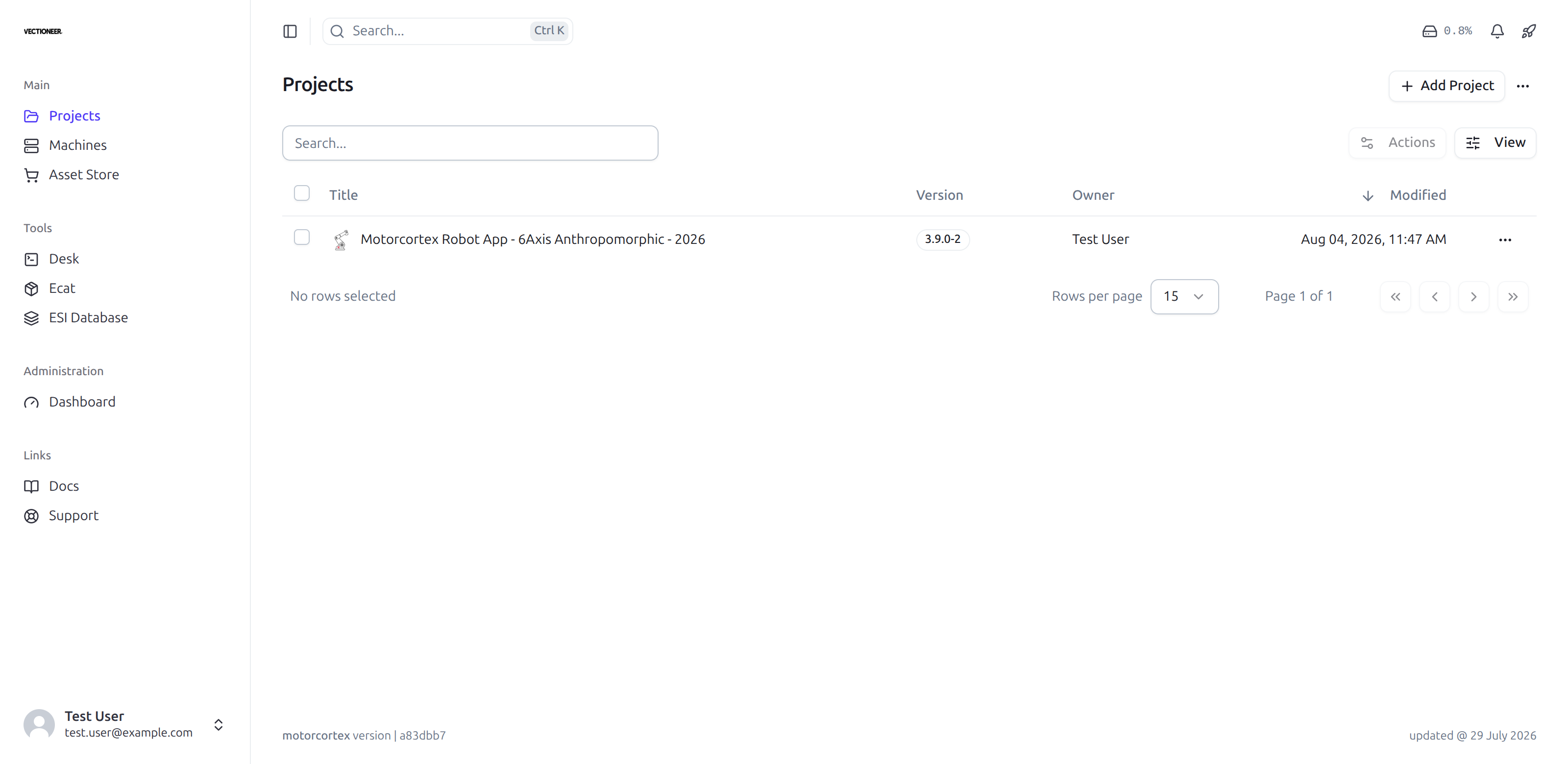
To create a project, click Add Project and fill in the title, description and version; an image is optional. The … button beside it holds the two other ways in: From store installs a ready-made project, and Upload project takes a .proj file from your PC.
Tip
Starting from a store project is usually faster than an empty one: it arrives with the package structure already in place.
Inside a project
Opening a project shows its contents split into Directories and Files. Packages appear as directories with a Type (binary, config, grid or home) and their own version.
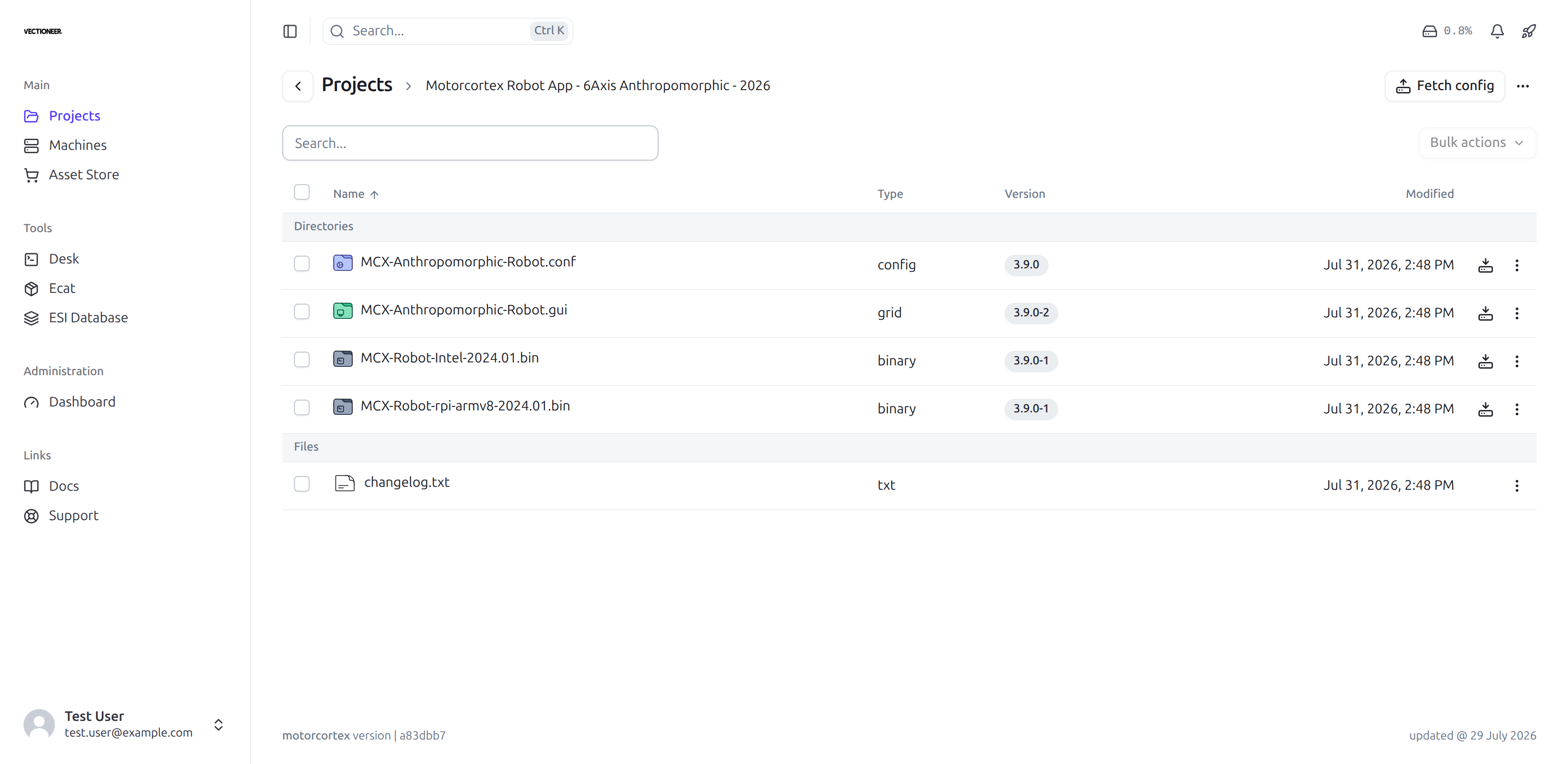
A Motorcortex application is built from three of these: a binary package with the compiled real-time application, a config package with its configuration, and a grid package with the user interface. The Project Packages chapter covers each one.
Adding and getting things out
Everything you add or export sits behind the … Actions menu at the top right.
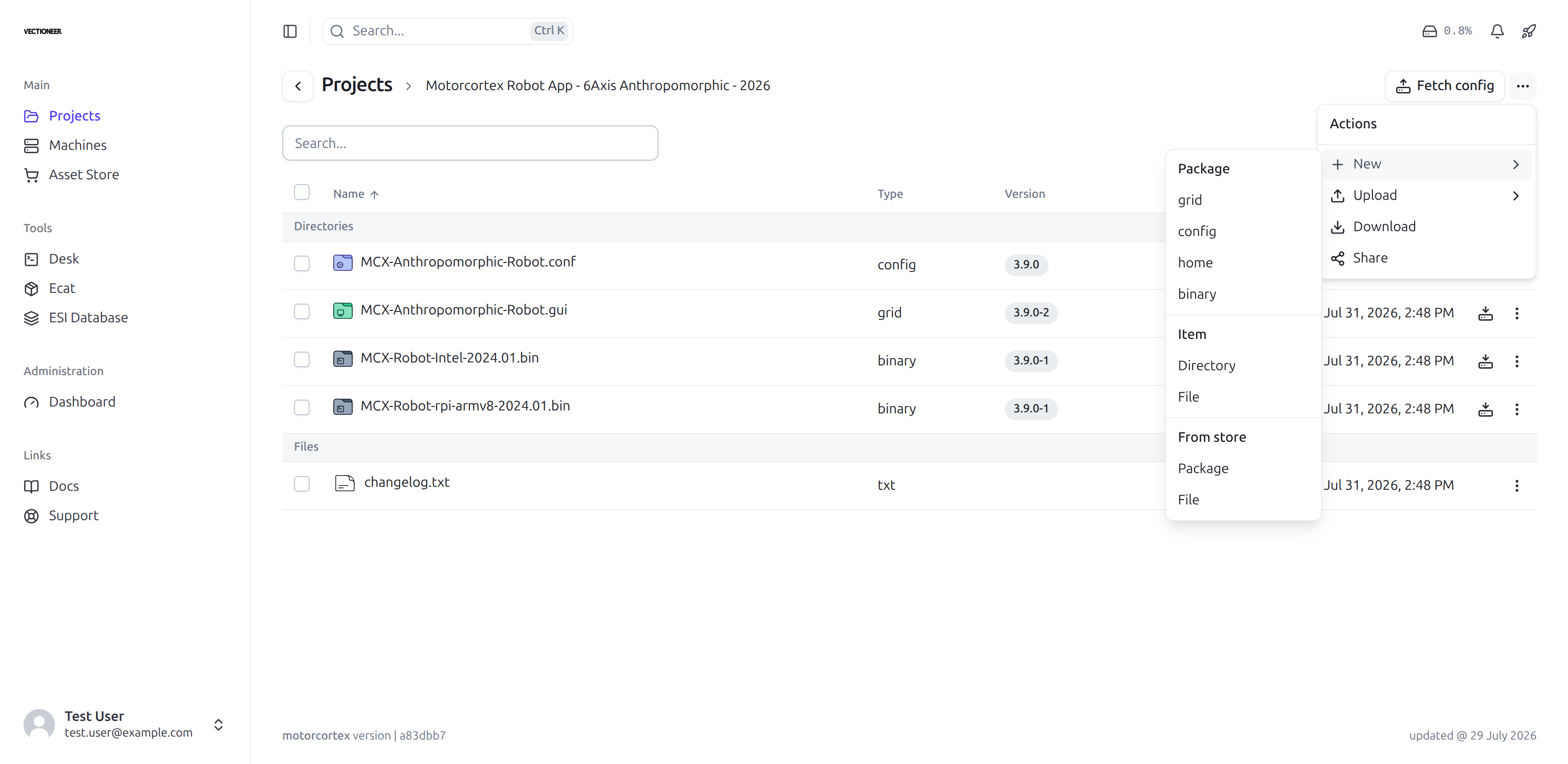
| Entry | What it does |
|---|---|
| New ▸ Package | Creates an empty grid, config, home or binary package |
| New ▸ Item | Creates a directory or a file |
| New ▸ From store | Installs a package or file from the Asset Store |
| Upload ▸ | Uploads files, a folder, or a packaged project from your PC |
| Download | Downloads the whole project to your PC |
| Share | Opens the project’s sharing settings |
Fetch config sits next to that menu as its own button. It reads the configuration currently active on a controller and stores it in the project, which is the reverse of deploying. Inside a binary, config or grid package, a Deploy button sends that package to a controller. Deploy an application walks you through it.
Bulk actions applies an action to the rows you tick, and each row has its own download button and ⋮ menu.
Virtual machines
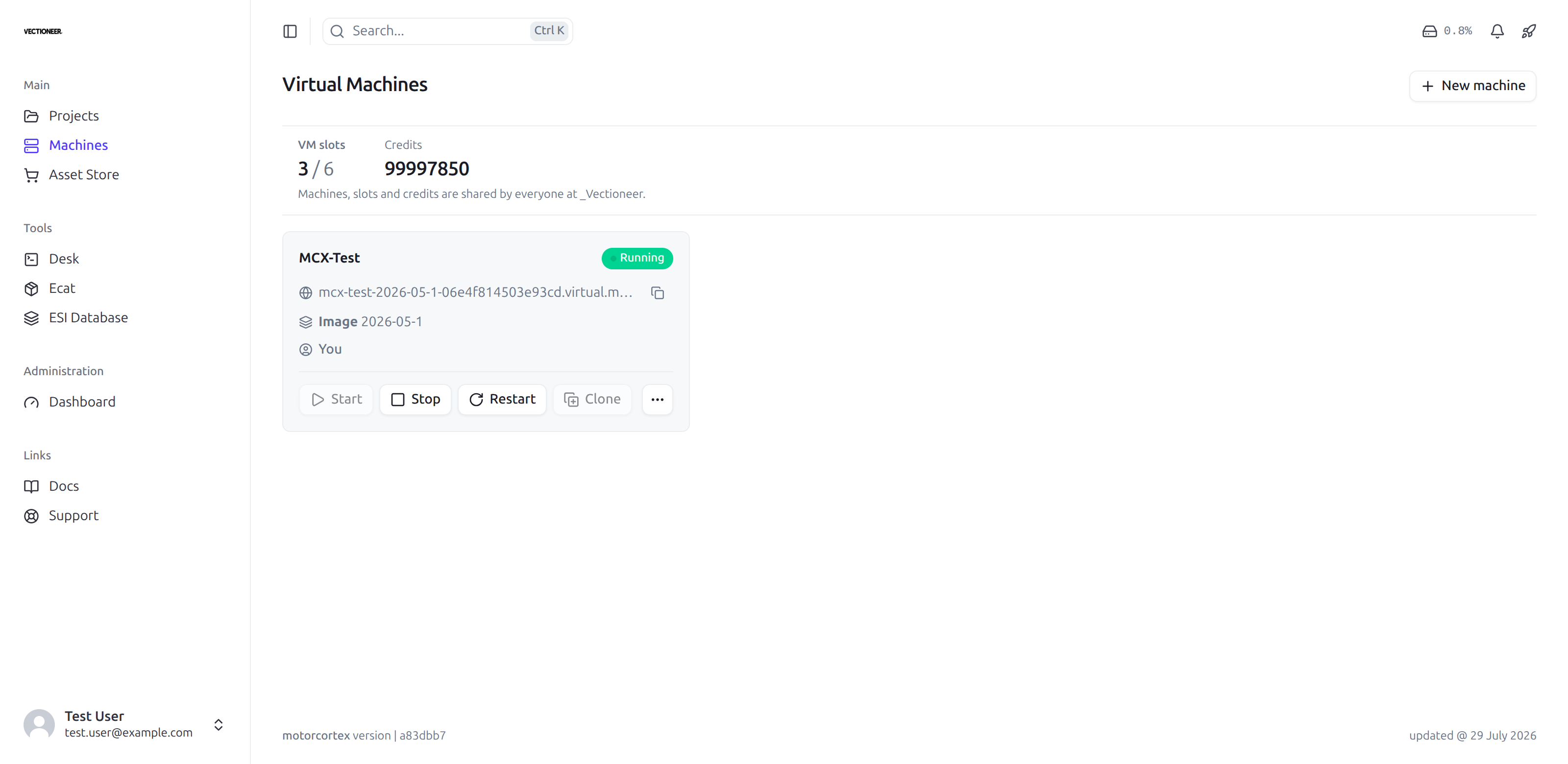
Machines lists the virtual controllers your organisation runs in the cloud. A virtual machine runs MCX-RTOS, so it gives you a Motorcortex controller to deploy to and test against without hardware. To create and use your first one, follow Use a cloud machine in Getting started.
If your organisation has no machines yet, the page shows Virtual machines are not enabled yet. Request access notifies the Motorcortex team, who contact you to set it up.
Slots and credits
Two counters sit at the top. Both are shared by everyone in your organisation, as the line beneath them states.
- VM slots is how many machines you have against the maximum. Every machine takes a slot, running or stopped, until you delete it. When all slots are in use, New machine reads
No VM slots available. - Credits is the budget the machines draw from. A running machine uses credits every minute; a stopped machine uses none. When the credits run out, running machines stop and Start is no longer available. Request credits asks the Motorcortex team for more.
Working with a machine
Each machine shows its name, state (Running or Stopped), address, the image version it runs, and its owner. The address ends in .virtual.motorcortex.io; Copy URL copies it. You use it wherever a tool asks for the controller’s address.
The buttons on the card cover the machine’s life cycle:
| Button | What it does |
|---|---|
| Start | Boots a stopped machine |
| Stop | Shuts the machine down, keeping its slot |
| Restart | Reboots a running machine |
| Clone | Creates copies of a stopped machine; each copy takes a slot |
Auto stop (⋯ menu) |
Sets how many minutes a running machine has left before it stops by itself |
Delete (⋯ menu) |
Removes the machine and frees its slot. This cannot be undone |
Warning
Stopping or restarting a machine interrupts anything deployed on it, including a running control application.
Auto stop keeps a forgotten machine from using up the credits. In its dialog, add time with +15 min, +30 min or +60 min, or type the minutes in Set time left to, and click Save. While the machine runs, the card counts down the minutes it has left.
New machine creates another one, which takes a free VM slot. You give it a Machine name of up to 20 letters, numbers and dashes, which becomes part of its address, and choose the Image version.
The Asset Store
The Asset Store holds the ready-made assets you install into a project or download to your PC: complete application projects, and the operating-system images and SDK you need to set up a controller or a development machine.
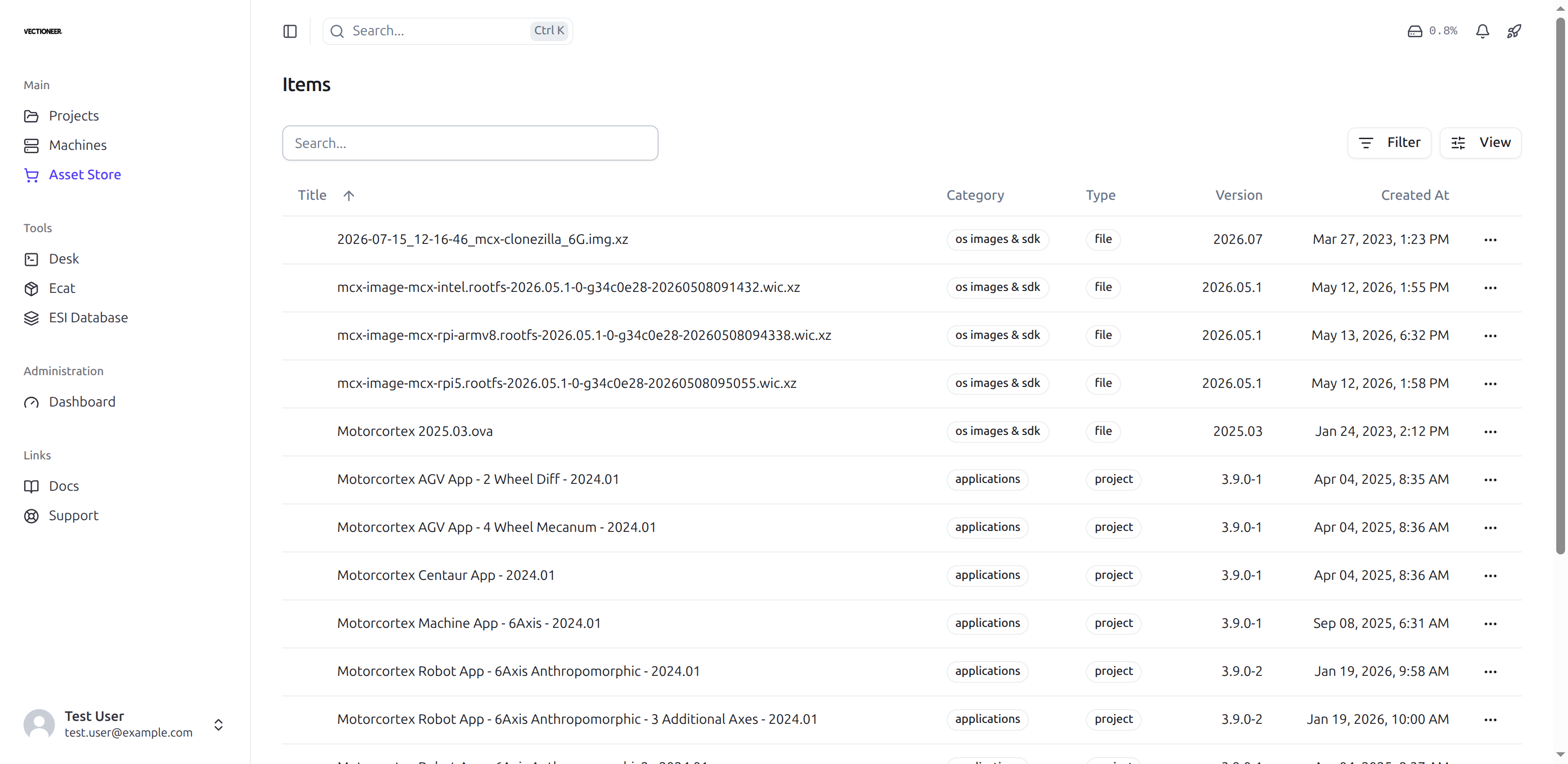
Every item carries a Category, a Type and a Version. Two categories are in use:
| Category | Holds |
|---|---|
applications |
Complete application projects: the Robot, Machine, AGV and Centaur apps in their several kinematic variants |
os images & sdk |
Controller OS images, a virtual-machine appliance, and the cross-development SDK |
Filter the list by category or type with Filter, choose columns with View, or search by title.
Getting an item
Each row’s … menu downloads the item. To install one straight into a project instead, open the project and use Actions ▸ New ▸ From store, which offers the store’s packages and files in place.
An applications item of type project becomes a whole new project: use Actions ▸ From store on the Projects page.
Motorcortex Desk
Desk opens desk.motorcortex.io, a plotting and parameter tool that runs in the browser independently of the portal. It starts disconnected: enter a controller’s address in its Connection panel and click Connect, then plot live signals, read and write parameters, measure, and export traces as CSV.
Because Desk connects on your behalf, it works against a physical controller and a virtual machine alike. Motorcortex Desk covers it in full.
Motorcortex ECAT
Ecat opens ecat.motorcortex.io, the tool that scans an EtherCAT network and configures the devices on it. See Motorcortex ECAT.
ESI Database
ESI Database lists the EtherCAT Slave Information files the portal knows about, by vendor, with the number of devices each file describes. Entries marked Public are available to every organisation.
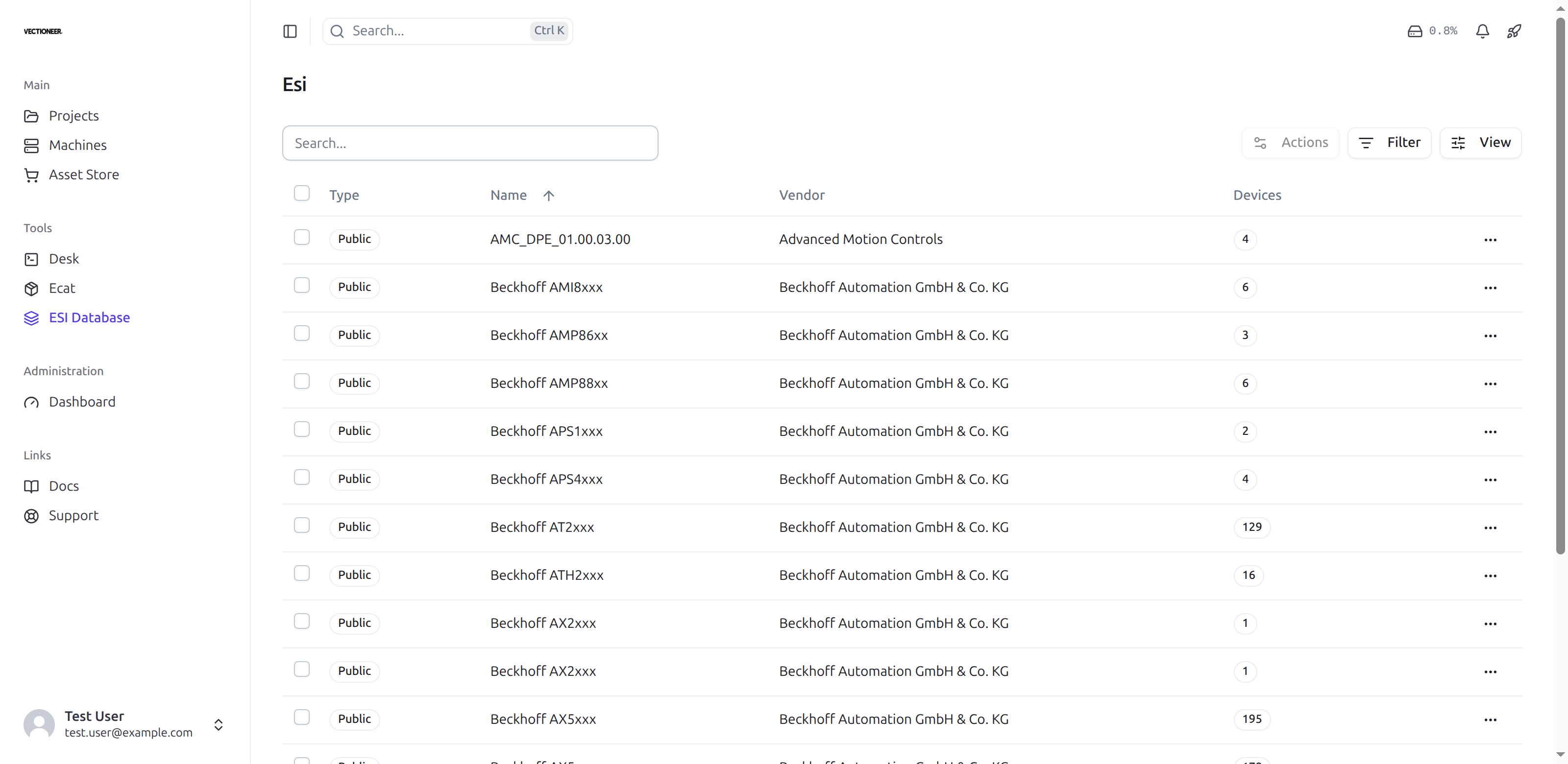
Filter and search the list to check whether a device you plan to use is already described. Actions holds the operations on the database itself.
Dashboard
The Dashboard reports what your organisation is using against what its subscription allows. It is about the organisation, not about you: your own settings live in the account menu.
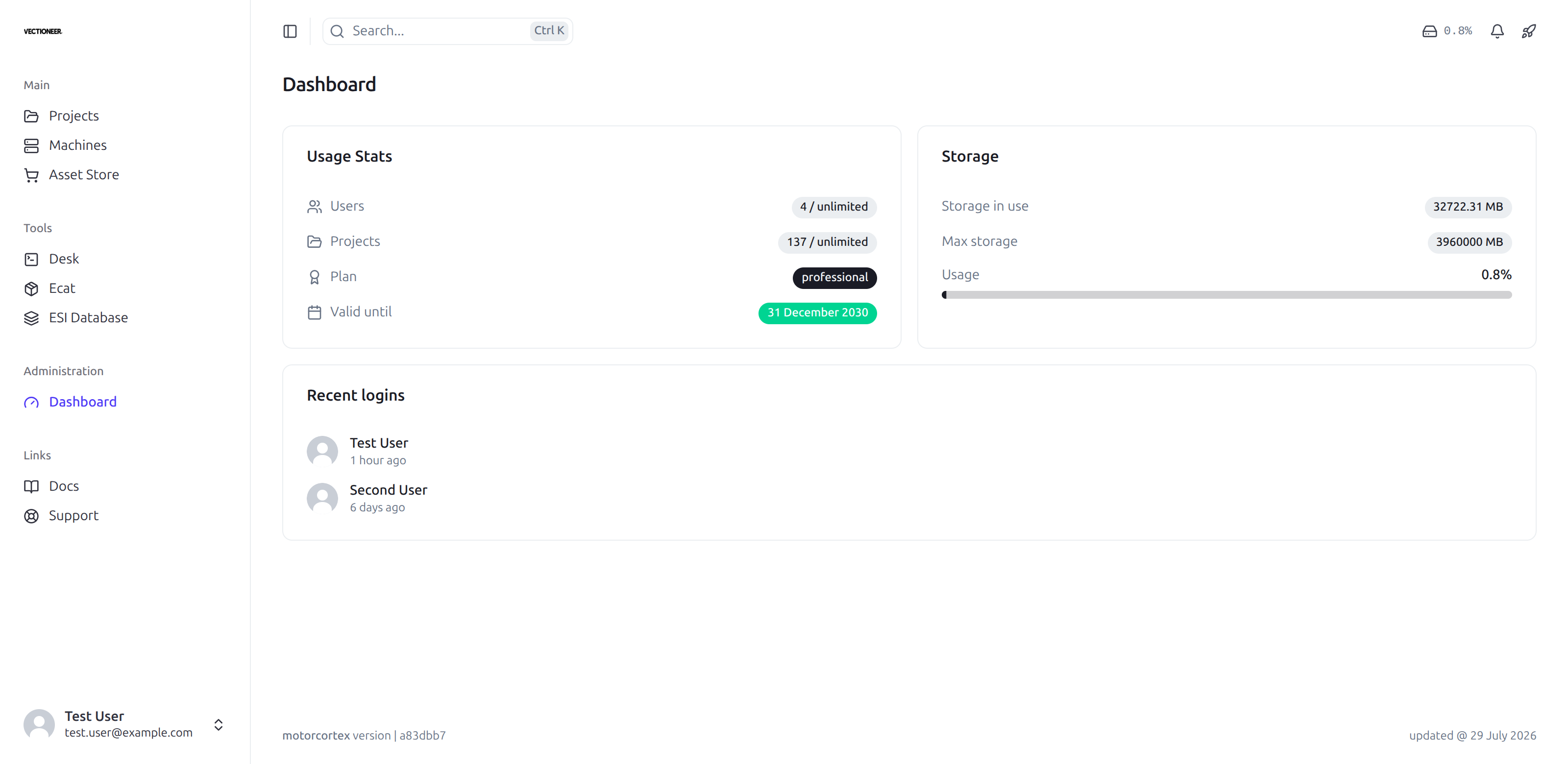
Usage Stats shows the number of users and projects against their limits, the subscription plan, and the date the subscription runs until. Limits depend on the plan.
Storage shows how much space the organisation’s projects occupy, the maximum, and the percentage in use. The same percentage sits in the top bar on every page.
Note
Once storage is full you cannot add files or packages to a project. Delete what you no longer need, or download it and remove it from the portal.
Recent logins lists who logged in and when.
The account menu
Your account sits at the bottom of the sidebar, showing your name and email. Clicking it opens the menu.
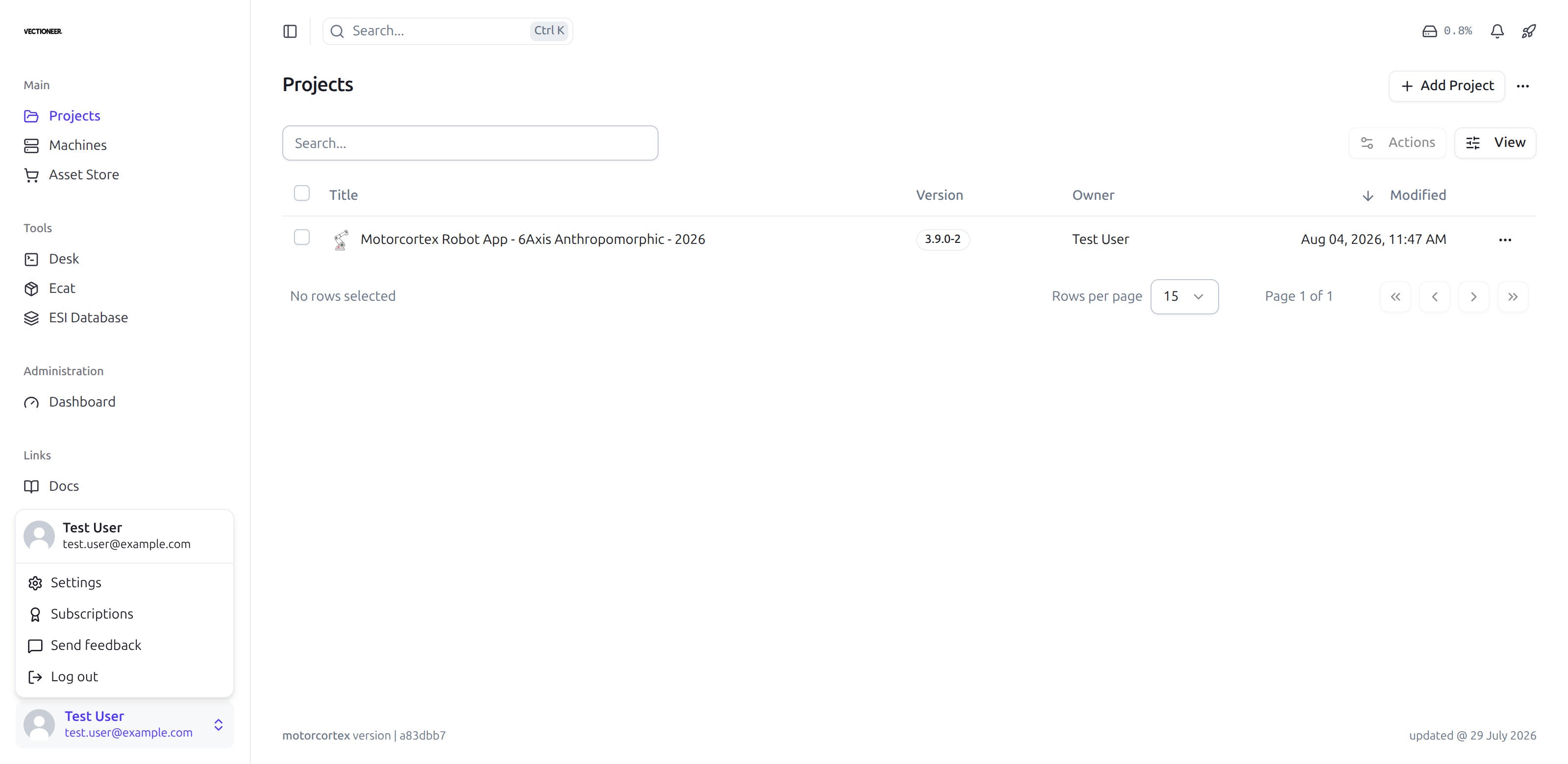
| Entry | What it opens |
|---|---|
| Settings | Your profile, security, password and appearance settings |
| Subscriptions | The organisation’s subscription |
| Send feedback | A form for reporting a problem or a request to Motorcortex |
| Log out | Ends the session |
Settings
Settings has four sections.
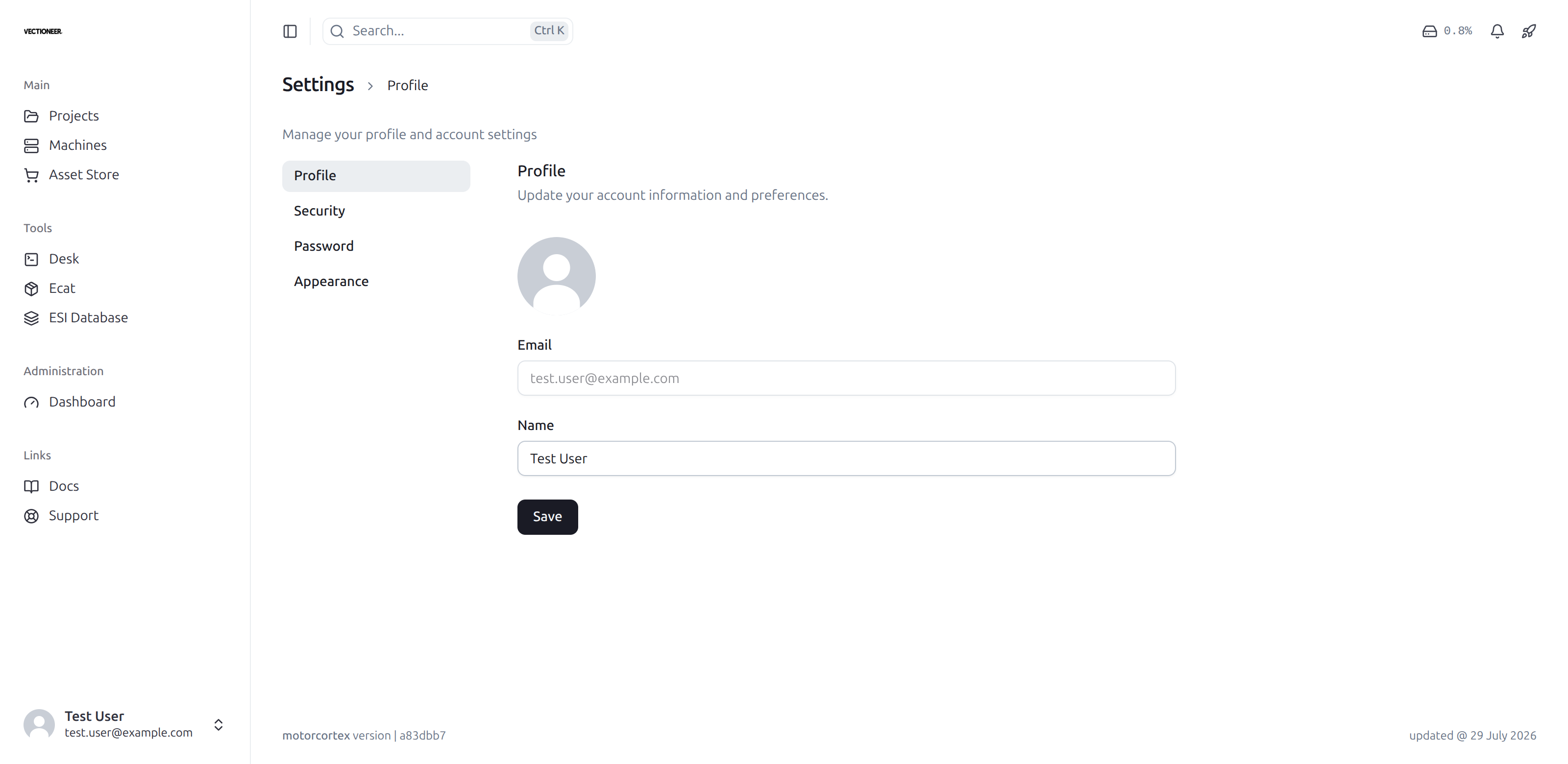
| Section | Covers |
|---|---|
| Profile | Your avatar, email address and name |
| Security | Account security. Re-enter your password to open it |
| Password | Changing your password |
| Appearance | Light, dark, or follow the system theme |
A new password must be at least 12 characters, no more than 72, and is checked against known breached passwords when you submit it. The form can suggest one for you.
Notifications
The bell in the top bar lists announcements about portal releases and services, newest first, with View all notifications at the foot of the list for the full history.
Next: Project Packages: what goes inside a binary, config and GRID package.